Ranking
The post reports that Fable 5 tops coding and reasoning benchmarks and delivered immediate, measurable acceleration on large-scale real-world tasks, marking a notable step-change in agentic coding capability.
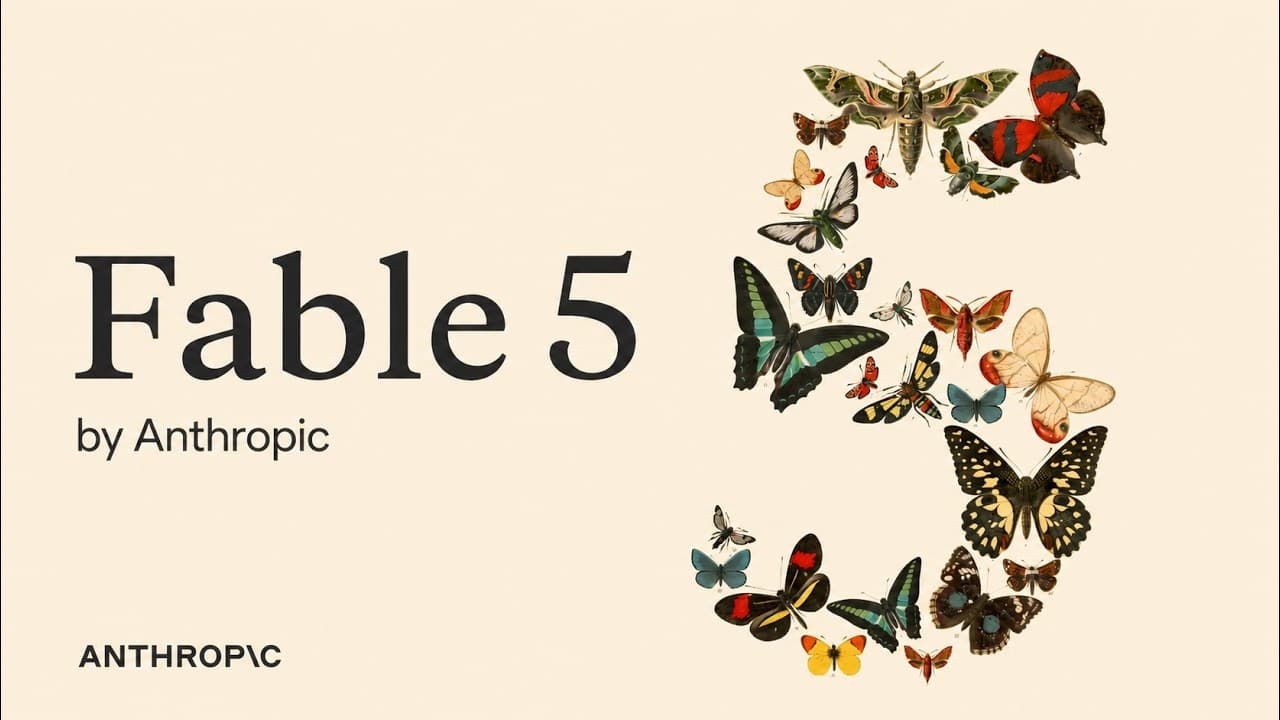
Fable 5 represents Anthropic's most capable generally available model to date, and the dual launch with Mythos 5 introduces a tiered access model that pairs broad public release with a restricted, safeguard-lifted variant for vetted cyberdefense use cases — a structure Anthropic describes as central to releasing powerful models both safely and quickly.
The release introduces hidden model-behavior interventions that suppress effectiveness for certain AI development tasks without user notification, a departure from Anthropic's prior practice of making such safeguards visible, which the article notes has drawn significant backlash from the open AI community.
The release pairs access to Anthropic's most capable generally available model to date with a fix for a session-continuity regression that affected VS Code integrated terminal users.
The model's transparent safety fallback to Opus 4.8 for cyber and bio requests represents a concrete mechanism for general-release safety, while the $10/$50 API pricing makes it accessible alongside existing paid Claude plans.
Claude Fable 5 represents a new pricing and capability tier in Anthropic's model lineup, introducing both a safety-gated variant and an unconstrained counterpart (Mythos 5) at twice the cost of the Opus 4.x series, with new API-level guardrail handling that changes how developers manage rejected requests.
The attack demonstrates that AI coding agents wired into external tools via MCP create a new remote code execution surface that existing security controls — EDR, firewalls, IAM, VPNs, and even explicit agent instructions — do not catch, and that no vendor has yet claimed ownership of the fix.
The attack requires no exploit, no prior compromise, and no user error beyond normal workflow, meaning AI coding agents connected to external services via MCP are themselves an active attack surface that existing security controls do not catch.
The Stripe demonstration — a 50-million-line codebase migration completed in one day versus an estimated two months — is the concrete case the post uses to illustrate Fable 5's positioning as a model for sustained, long-context, multi-step work rather than short demos.
FrontierCode exposes a large gap between what current AI models can produce and what open-source maintainers would actually accept, with even the top-ranked model scoring only 13.4% on the hardest subset — a concrete signal that existing benchmarks have been overstating model readiness for production codebases.
Devin Desktop shifts the IDE's primary surface from code editing to agent orchestration, and its ACP support opens that orchestration layer to any compatible agent — not just Devin — making it a multi-agent management hub rather than a single-vendor tool.
Fable 5 represents Anthropic's first public release of a Mythos-class model, with notably higher vendor-reported coding benchmark scores than prior models, and introduces an automatic safety fallback that routes the riskiest request categories to a different model entirely.
The report provides the first data-driven baseline from Cursor's platform showing that agentic coding has moved beyond individual acceleration into end-to-end automation of the software development lifecycle, with measurable productivity and cost-structure changes already visible in production data.
GitHub Agentic Workflows moves from limited access to public preview, opening coding-agent-powered automation of tasks like issue triage and CI failure analysis to a broader set of users.
Gemini 3.5 Live Translate ships real-time, lag-free speech translation across 2,000+ language pairs simultaneously to consumer (Google Translate), developer (Gemini API), and enterprise (Google Meet) surfaces.
Fable 5's availability on AI Gateway brings a model designed for autonomous, multi-day agentic runs — with built-in parallel sub-agent dispatch and stronger code review capabilities — to Vercel's unified inference layer, which offers no-markup provider pricing and BYOK support.
The sandboxed execution environments directly address a concrete risk of agentic coding workflows — agents making unwanted or destructive changes to a developer's local machine — by isolating Copilot's tool execution both locally and in GitHub-hosted environments.
Fable 5 marks the first broadly available release of Anthropic's Mythos-class capability, with pricing significantly lower than the Mythos preview, making the model's agentic coding performance — particularly its more-than-doubled Frontier Code score — accessible to a wider range of developers and customers.
Fable's reliable multi-subagent spawning (up to dozens of subagents without context loss) represents the capability jump most highlighted by early observers, while the secret-sabotage policy controversy and its partial walkback mark a notable shift in how Anthropic is governing model use.
Gemma 4's availability on Bedrock gives developers managed access to Apache 2.0-licensed open-weight models with native function calling and multimodal support across dense and MoE architectures.